Controversies in Military Ethics & Security Policy
How Russia Could Escalate Its War on Europe
Introduction
When discussing a potential Russian attack against a NATO member state, the years 2029–2030 are increasingly treated as critical milestones. German military and intelligence assessments, along with multiple European forecasts, suggest that by the end of the decade Russia could regenerate sufficient military capacity to challenge NATO directly. Yet focusing excessively on these dates risks creating a false sense of certainty. Strategic timelines are not determined by force generation alone. As Jana Puglierin argues, state behavior emerges from the interaction of intentions, capabilities, and perceived opportunities.[1] The key question is therefore not simply when Russia will be militarily ready, but when Moscow may perceive conditions as sufficiently favorable.
The assumption that Russia requires several more years before contemplating a direct confrontation with NATO rests largely on quantitative calculations, which resemble miscalculations of 2021 and early 2022. While Russian forces have suffered enormous casualties and equipment losses, the Kremlin’s logic of power grab adds qualitative variables. The Russian regime needs achievements that can be presented as a victory and that may not be significant territorial gains in Ukraine or NATO states but strategic objectives like dismantling the Alliance through exposing its disunity and unpreparedness.
Russia struggles to move beyond villages like Mala Tokmachka in Ukraine — where fighting has dragged on longer than the legendary siege of Carthage — but it can nonetheless succeed in disrupting Trans-Atlantic relations and meddling with political elites’ and populations’ opinions on defense and geopolitics. Moreover, its provocations against NATO states – e.g., violations of Polish or Romanian airspace – exposed a complete lack of preparedness to respond to new challenges and may motivate Russia to go all-in much earlier than experts expect. Despite heavy losses in manpower, the Kremlin may organize mobilization after the autumn elections in Russia, while we are already witnessing the rebirth of the Russian army, an army that is trained in modern warfare and insensitive to human losses – something European armies are lacking.
Hence, two opposing conclusions can be drawn. The first is skepticism about Russia’s ability to threaten NATO militarily amid modest results of the so-called “special military operation”. The second is that the Kremlin may conclude it is time to pursue a larger strategic prize: not another costly march toward Kyiv, but the weakening or effective dismantling of NATO’s cohesion which will be a major symbolic triumph, perfectly aligned with Russia’s geopolitical objectives in the present circumstances, especially the U.S.’s primary focus on China and grudge against NATO because of weak support in the war with Iran. Moreover, should the U.S. and China engage in conflict, Russia will immediately expand its aggression in its sphere of interest – which is the European post-Soviet space and beyond.
Russia is already at war with Europe
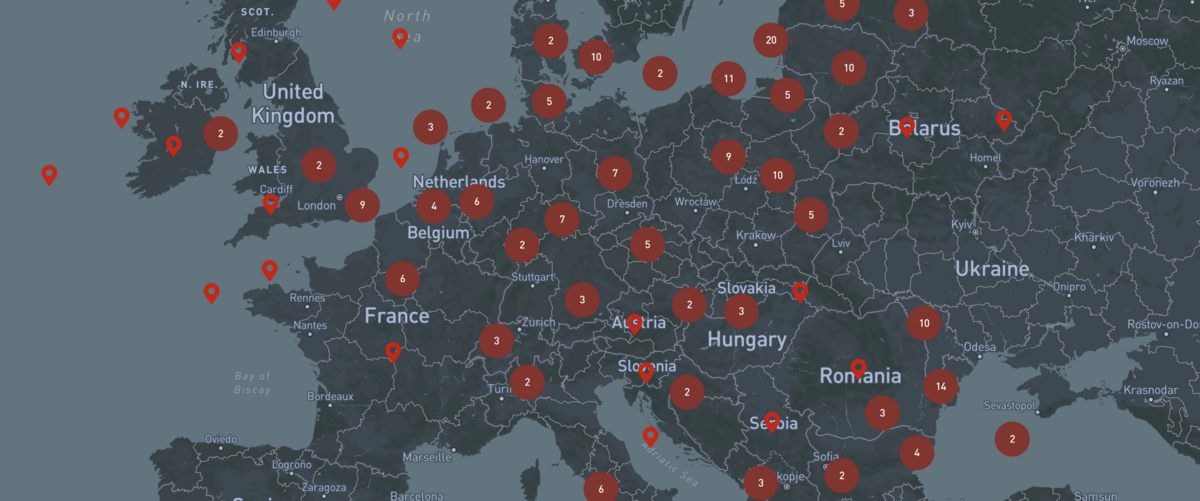
One of the main flaws in debates about Russia is the persistent assumption that Europe currently exists in a state of peace — or, if not peace, then at least not in a state of war. The Sahaidachnyi Security Center’s Everywhere War Tracker[2]clearly demonstrates the opposite because even the kinetic elements of war are simmering. Moreover, Russian military thought increasingly conceptualizes conflict as a continuum in which political, informational, economic, cyber, and kinetic instruments operate simultaneously rather than sequentially. In the Denied War report, based on research by the Sahaidachnyi Security Center think tank[3], we argue that, fully in line with Russian authentic fighting doctrine, Moscow considers hybrid activities not as substitutes or a distinct type of a war but rather a concrete stage of environment-shaping operations preparing conditions for later military action.
An important part of the environment shaping is also cognitive – or mental[4] as Russia calls it – warfare. Russia sees itself in a civilizational confrontation and thus an existential war, where only one mindset can prevail while the other one should become extinct. Overall, while Russia might plan to restore its Soviet-time influence in Europe, it aims higher – at destroying the mindset of democratic societies and dismantling the European project, which will be a Russian strategic victory even amid little or no territory gains.
Evidence increasingly supports this interpretation. The Everywhere War Tracker documents a broad range of sub-threshold incidents across Europe, including cyber operations, maritime intrusions, sabotage activities, airspace violations, GPS interference, and critical infrastructure disruptions. Rather than being isolated events, their cumulative trajectory demonstrates both quantitative growth and qualitative evolution.
The Denied War report also observes a clear transition from early-stage “noise” to the operational preparation of the environment since mid-2023 in Russian sub-threshold activities. Activities have evolved from influence operations, disinformation campaigns, and sporadic cyber harassment toward infrastructure disruptions, activities of dedicated sabotage networks, electronic warfare attacks, airspace violations and systematic reconnaissance of strategic facilities.
Drone activity illustrates this transformation particularly clearly. Initially perceived largely as provocative actions, repeated UAV incursions over strategic sites, military facilities, and critical infrastructure may increasingly serve military purposes beyond signaling alone. Gathering intelligence, mapping infrastructure, testing air defense, identifying vulnerabilities, collecting targeting data, and testing response times represent functions associated with operational planning.
Seen from this perspective, Russia may not be preparing for war against Europe. It may already be conducting one. The primary uncertainty is not about whether hostilities exist, but where the threshold into undeniable military confrontation ultimately lies.
From sub-threshold to undeniable war: an operational scenario
One of the greatest analytical weaknesses in Western threat assessment is the persistent expectation that a future confrontation with Russia will resemble twentieth-century models of conventional war. Instead, Russia will attack differently. It will most likely synthesize its traditional strategic doctrine with the newly acquired operational experience and new-generation warfare capabilities forged in Ukraine. While European militaries observe these individual components – drone swarms, adaptive electronic warfare, dense real-time tactical kill-web, dispersed combined-arms ground maneuver, unmanned logistics and other things – on the Ukrainian battlefield, they fundamentally misjudge how this lethal algorithm will be synchronized and applied directly against NATO territory.
The Denied War report argues that the transition to war will not manifest as a sudden mechanized blitzkrieg across a border. Rather, it will unfold through a highly orchestrated operational pathway designed to blind, paralyze, and bleed the defender before large-scale ground combat even begins. If activated, this operational pathway would likely unfold across four integrated phases.
The first phase is actually the transition from sub-threshold to full-scale overt hostilities. After achieving the initial objective of desensitization – conditioning allied nations to a baseline of sub-threshold friction so that the crisis feels routine – the threshold into open conflict will be crossed with coordinated cyber and cyber-physical sabotage against critical infrastructure combined with cognitive / information operations to induce systemic shock – a manufactured sensation that “everything is collapsing”. Activated sleeper cells and deniable networks would attempt to target power grids, offshore energy infrastructure, subsea cables and optical fiber backbones (the “achilles heel” of the Nordic-Baltic region), and disable railway junctions. Crucially, port facilities would be prioritized for sabotage to explicitly hinder the arrival of NATO reinforcements and induce logistical chaos. Drone-enabled sabotage operations against energy and military infrastructure, including NATO air bases, modeled on the Ukrainian “Spiderweb” operation[5], will be likely waged using tanker fleets and pre-disposed sleeper cells throughout the European continent.
At the almost synchronous second phase, Russia would launch a comprehensive, multi-domain air offensive targeting operational depth. Russia stockpiles and continues to produce an enormous mass of cruise and ballistic missiles. The Iskander-M tactical ballistic missile system (200+ deposit and 60 units produced per month)[6] presents a particular menace as Europe has no immunity to it except for limited U.S.-exported Patriot PAC-3 arsenal. Its 500 km range allows it to cover any target in Latvia, Lithuania, Estonia, and parts of Poland, Germany, and Sweden. Moscow also recently started mass-producing a 1000-km Iskander modification[7] that can reach most of Europe. The Denied War report points to the fact of particular concentration of these systems within the 152nd Missile Brigade in the Kaliningrad exclave, along with “Uragan” and “Smerch” Multiple Lauch Rocket Systems within the 244th Artillery Brigade.
However, the air campaign would move beyond traditional missiles to heavily incorporate cheap and scalable long- and medium-range platforms: massed Geran/Gerber family fixed-wing UAVs, loitering munitions, UAV “motherships” with autonomous kamikaze munitions and mining assets, and automated relay systems designed to degrade command nodes and coastal logistics. A primary strategic objective during this phase is the preemptive neutralization of NATO’s high-end strategic platforms and airpower on the ground. While the success of this effort remains uncertain given NATO’s dispersal and physical protection measures, relying entirely on the assumption of unquestioned Western standalone air dominance is a dangerous gamble. Ukraine and Iran cases studies suggest that hybrid approaches combining massed unmanned systems and traditional airpower can severely challenge legacy aviation doctrines.
On the next phase, assuming Western airborne and naval assets survive and respond, Russia’s strategy relies on extreme asset dispersal and the establishment of a localized, highly lethal engagement area. This 40+ kilometer deep “kill zone” would be rendered virtually impenetrable to allied electronic assets. It relies on the mass deployment of unmanned systems crews integrated with layered ground-based air defenses. Advanced EW would suppress defender communications and networked systems while preserving safe, frequency-hopping, and fiber-optic command links for Russian forces. Operating within this bubble, highly experienced, dispersed teams of drone operators, akin to Russia's “Rubikon” drone unit, would systematically dismantle near-rear logistics and suppress any first-line strongholds.
Subsequently, once situational awareness is shattered and the kill zone established, Russian ground forces would advance on the ground. But instead of massive armored columns, this phase would rely on legions of tactical micro-groups operating under the autonomous, terminal-guidance cover of FPV drones and other lethal systems. While they could advance rapidly if facing an unprepared target, their default approach would be the methodical, creeping advance mastered in Ukraine to seize and hold key nodes. Once territory is taken, a fortified physical and electromagnetic bubble is erected to paralyze sustained counterattacks.
This final stage would likely be territorial anchoring. Russian planners understand they cannot win a full-scale long-range and long-lasting technological standoff with the West. By forcing the conflict into a protracted, bloody, close-quarters ground war on NATO soil, Russia seeks to exploit Europe’s lowest threshold: its societal intolerance for high human casualties. The political purpose will be not to seize big territories but to humiliate NATO and politically destroy it by proving it incapable.
Within such an operational scenario, assessing the balance of power through the raw calculus of legacy mechanized brigades is dangerously obsolete. The true metrics of readiness and deterrence now dictate a shift in focus toward affordable precision mass and agile electronic warfare on both the strategic and tactical level, layered air defense incorporating counter-UAS systems, resilient command and control, and highly adaptive last-mile logistics considering fusion in lethality between the frontline and rear.
Geostrategic scenarios of potential Russian aggression
The Suwałki gambit
Among the scenarios examined in The Denied War, the seizure of the Suwałki Gap appears as either the most plausible option or the indispensable part of all other broader options. The 65-km corridor (linear distance) between Belarus and Kaliningrad (linear distance) represents both Russian and NATO’s principal geographic vulnerability in the Baltic region. Its seizure would isolate the Baltic states from land reinforcement and create a limited territorial objective capable of generating disproportionate strategic effects. At the same time, from Moscow’s perspective, its existence poses a permanent of a blockade of Kaliningrad by NATO forces, given the Alliance decides to do so, which could severely constrain Russia’s subsequent options. Only control of the Suwałki Gap mitigates this risk. Otherwise, in any broader conventional war, a combined land and naval blockade remains a plausible Allied response. This strategic weakness explains why Russia is almost certainly planning its initial moves around securing the Suwałki Gap.
Full-scale regional war in the Baltics
A large-scale Russian offensive against the Baltic states would integrate simultaneous operations across land, sea, air, cyber, and space domains, leveraging advanced technologies such as massed missile-drone strikes, drone swarms, electronic warfare, and naval drones. On the ground, it would involve multi-axis advances from Belarus, with primary emphasis on seizing the Suwałki Corridor, in an effort to rapidly paralyze the defense of the entire region and demonstrate full-scale war with NATO.
Russia’s strategic culture favors ambitious, high-risk operations over limited objectives. As seen in the 2022 invasion of Ukraine, where Moscow launched simultaneous advances on multiple axes rather than concentrating on more achievable goals like the Donbas, the Kremlin often opts for maximalist gambles. This pattern, combined with Putin’s apparent overconfidence in its military power (bred by misleading victorious reports from his generals), makes a broad offensive aimed at the rapid capitulation of Estonia, Latvia, and Lithuania a credible contingency.
Gotland / Saaremaa / Hiiumaa seizure
The Denied War report considers independent Russian operations against Gotland and some strategic islands in the Baltic Sea relatively unlikely. However, within a broader regional conflict these islands could become supporting objectives. The strategic objective would be to create a strong Anti-Access/Area Denial (A2/AD) zone using anti-ship missiles, air defenses, and aerial and naval drone capabilities. This would block NATO naval reinforcements, isolate the Baltic states, and provide leverage for diplomatic ultimatums. However, operational risks are substantial. As demonstrated by coastal and island operations in the Russo-Ukrainian war, particularly Snake Island, an exposed garrison without secure, redundant logistics is highly vulnerable to isolation and eventual destruction. In the contested waters of the central Baltic, Russia cannot guarantee sustained supply lines. Consequently, any force deployed to these islands would lack strategic depth and could be systematically neutralized by NATO at a time of its choosing.
Arctic escalation
The probability of a Russian attack on the the Svalbard archipelago depends heavily on the broader strategic context. As a standalone “limited invasion” it ranks among the least likely scenarios. However, in the event of a full-scale war in the Baltic region, a concurrent operation against Svalbard becomes highly probable as a secondary theater. Russia would likely seek to transform the archipelago into a forward base for air defenses, anti-ship missiles, radars, and drone operations. This would extend its A2/AD coverage across the North Atlantic, interdict NATO reinforcements, and divert Allied air and naval assets away from the primary theater. Military planning, as observed in recent “Zapad” exercises,[8] points to a coup de main operation: a surprise amphibious landing under the cover of naval drills, preceded by large-scale missile and drone strikes on Norwegian airfields and ports. Russia’s Kola Peninsula bastion, strategic bombers, and submarine fleet provide a strong foundation for this initial phase.
Attack on Finland and Norway
According to the Denied War report, this remains the least probable scenario, bordering on unrealistic as a primary operation. It would involve a direct ground offensive from Murmansk into Finnmark (Norway) or from Petrozavodsk toward Joensuu and Rovaniemi in Finnish Lapland and Karelia. The theoretical aim would be to establish a defensive buffer protecting Russia’s Kola Peninsula nuclear submarine bastions and securing dominance over the Barents Sea. Although open-source intelligence shows Russian military construction near the Finnish border, including new divisions and an army corps in Karelia, these efforts appear primarily defensive. They are intended to secure Russia’s northern flank while its main forces are engaged elsewhere, rather than to support large-scale territorial conquest. The allocated forces are inadequate for seizing and holding vast, difficult terrain against determined resistance.
Is Russia capable of attacking Europe?
Current battlefield tensions may actively stimulate a limited attack against a NATO member state. For instance, the Kremlin’s calculus could involve leveraging this escalation to demand an immediate cessation of Western support for Ukraine in exchange for halting its aggression. Recent Russian actions confirm this operational groundwork, notably Vladimir Putin’s decree authorizing the use of Russian armed forces abroad under the pretext of protecting Russian citizens,[9] which coincided with a disinformation campaign against the Baltic states inside Russia.[10]
Russian military capabilities should not be underestimated. Ukraine today represents one of the most fortified and combat-experienced military environments in the world. Years of battlefield adaptation have transformed it into a highly lethal battlespace saturated with drones, electronic warfare systems, precision fires, and extensive defensive engineering. Yet Europe does not necessarily present the same challenge.
Paradoxically, despite NATO’s aggregate superiority built for the previous-generation warfare, Europe may represent an easier target than Ukraine under the evolving circumstances. Firstly, European rearmament remains slower than the threat environment demands. Despite major announcements, military procurement cycles continue to operate on peacetime timelines while Russian industry increasingly functions under wartime conditions.
Secondly, it is not about stockpiles alone, but primarily about the new military technology and personnel skilled to use it for fighting the new-generation war. European militaries must avoid the trap of comparing themselves to Russia or assuming their potential response would mirror the fierce resistance currently demonstrated by Ukraine. After four years of high-intensity war, both Russia and Ukraine have not only accumulated colossal combat experience but have also forged the foundational capabilities of a new generation of unmanned, algorithmic war of attrition. These capabilities remain either non-existent or in their infancy across Europe. This gap will grant Russia exponentially higher tactical capabilities and an asymmetric advantage on a European battlefield. For European armies, a direct clash would not resemble the grinding, prolonged battle for a village like Mala Tokmachka; instead, it would likely feature a rapid Russian advance dozens of kilometers deep, accompanied by the immediate deployment of highly lethal kill zones.
Multiple Ukrainian red teaming exercises and theoretical wargames have exposed these vulnerabilities.[11] Yet they have shown not only a lack of preparedness among European armies, but also political hesitation and disunity in times of crisis. Ukraine has become the world’s largest laboratory for modern warfare, forcing continuous adaptation in drone employment, electronic warfare, targeting cycles, distributed operations, and battlefield innovation. Many European militaries remain at an earlier stage of this adaptation process.
Thirdly, threat perception across Europe remains fragmented. Northern and Eastern flank countries increasingly perceive Russia as a long-term existential challenge, while parts of Central, Southern and Western Europe often prioritize other security concerns. Moreover, decades of relative peace have shaped strategic cultures emphasizing crisis management over societal mobilization. While European societies have demonstrated substantial solidarity with Ukraine, supporting a partner under attack and accepting direct military risks are fundamentally different political choices. Protests against the return of conscription in Germany is one such example.
Fourth, uncertainty surrounding the United States, which has itself become bogged down in the war against Iran and seems unwilling to challenge China over Taiwan, introduces another variable into Russian calculations. Perceptions of declining willingness to sustain extensive commitments abroad, strategic prioritization of the Indo-Pacific, and political debates regarding NATO obligations may alter Moscow’s assessment of risks and opportunities. Article 5 has always depended not only on legal commitments but on political resolve.
Ultimately, assessing the Russian threat is not a matter of prophecy – a simplistic binary of whether Russia will attack Europe or not. Ukrainian longstanding experience of its antagonistic relationships with Russia shows that the latter has a long-standing strategic culture that prioritizes playing the long game. It shapes the operational environment well in advance, getting ready to strike wherever favorable windows of opportunity allow it to, and is significantly less likely to act if those windows remain closed. Therefore, without exaggeration, the higher Europe’s level of preparedness for an attack, the lower the probability of that aggression occurring.
The question therefore is not whether Russia can export the war against Ukraine further into Europe. The question is how the Kremlin may plan to do so.
Conclusion
Debates about a future Russian attack on Europe often oscillate between two extremes. One school argues that Russia’s poor battlefield performance in Ukraine, mounting economic pressures, and immense casualties make a direct confrontation with NATO improbable. Another sees an almost inevitable countdown toward war by 2029–2030. Both perspectives risk oversimplifying a much more complex reality.
The question is not whether Russia is weak or strong in absolute terms. The question is whether Russia may identify a favorable combination of intentions, capabilities, and opportunities.
The evidence increasingly suggests that Moscow is systematically generating options. The Denied War report demonstrates that Russian military thinking does not separate sub-threshold activities from conventional conflict but treats them as sequential components of a unified campaign. Current activities across Europe increasingly resemble operational preparation of the environment rather than isolated acts of pressure. Considered separately, they do not necessarily indicate military escalation, but collectively suggest the gradual shaping of conditions under which escalation could occur if perceived opportunities emerge.
Furthermore, Russia’s threat should not be measured primarily by counting tanks, aircraft, or divisions. The war in Ukraine has demonstrated that numerical comparisons increasingly fail to capture the evolving character of warfare. Russia has adapted faster than many expected in several critical domains. It has transformed large portions of its military into a system built around unmanned technologies, electronic warfare, long-range precision strikes, dispersed operations, and high tolerance for attrition. At the same time, it has continued integrating military and non-military instruments into a single strategic logic.
Europe faces a different challenge. Despite possessing considerable aggregate economic and military potential, adaptation remains uneven. Rearmament is accelerating but often still follows peacetime rhythms and outdated prioritization logic. Threat perceptions differ significantly among member states. Strategic cultures developed during decades of relative peace continue influencing societal and political willingness to accept risk. Many European militaries remain in the early stages of adapting to the lessons emerging from Ukraine.
Most importantly, deterrence depends not only on capabilities but on perceptions. Moscow does not require certainty of success. It only requires sufficient doubt regarding Western unity and response.
If this is correct, Europe should prepare not simply for the possibility of Russian aggression, but for a strategic environment in which the distinction between peace and war has already become increasingly difficult to identify.
Updated on 29 July 2026.
[1] Cf. Puglierin, Jana (2026): Wer verteidigt Europa? Hamburg, p. 48.
[4] See Davlikanova, Elena (2026): Going mental: Russia’s cognitive war against Europe. European Policy Institute in Kyiv, 28. Mai. epik.eu/publication/cognitive-war/.
[5] Petrenko, Roman (2025): Ukraine's Operation Spiderweb: 18 months in the planning, 41 Russian bombers hit – photos. In: Ukrainska Pravda, June 1. www.pravda.com.ua/eng/news/2025/06/01/7515065/.
[9] Protz, Anastasia (2026): Putin signs law enabling him to deploy Russian troops abroad to “protect” Russian citizens. In: Ukrainska Pravda, May 25. www.pravda.com.ua/eng/news/2026/05/25/8036357/.
In der Diskussion über einen möglichen russischen Angriff auf einen NATO-Mitgliedstaat stehen zunehmen die Jahre 2029–2030 als entscheidende Wegmarken im Fokus. Deutsche Militär- und Geheimdienstanalysen sowie zahlreiche europäische Prognosen deuten darauf hin, dass Russland bis zum Ende dieses Jahrzehnts wieder ausreichende militärische Kapazitäten aufbauen könnte, um die NATO direkt herauszufordern. Eine übermäßige Fokussierung auf diese Daten birgt jedoch die Gefahr einer falschen Gewissheit. Strategische Zeitpläne werden nicht allein durch den Aufbau militärischer Kräfte bestimmt. Wie Jana Puglierin argumentiert, ergibt sich das Verhalten eines Staates aus dem Zusammenspiel von Absichten, Fähigkeiten und wahrgenommenen Chancen[1]. Die entscheidende Frage lautet daher nicht einfach, wann Russland militärisch bereit sein wird, sondern wann Moskau die Bedingungen als ausreichend günstig einschätzt.
Die Annahme, Russland könne noch mehrere Jahre benötigen, bevor es eine direkte Konfrontation mit der NATO in Betracht zieht, beruht weitgehend auf quantitativen Berechnungen – diese ähneln allerdings den Fehleinschätzungen von 2021 und Anfang 2022. Zwar haben die russischen Streitkräfte enorme Verluste an Soldaten und Ausrüstung erlitten, doch das opportunistische, an Machtgewinn orientierte Denken des Kremls bringt qualitative Variablen ins Spiel. Das russische Regime braucht Erfolge, die als Siege präsentiert werden können. Dabei muss es sich nicht unbedingt um bedeutende Gebietsgewinne in der Ukraine oder in NATO-Staaten handeln. Auch die Erreichung strategischer Ziele fällt darunter, etwa die Zerschlagung des Bündnisses selbst, indem die Uneinigkeit und Unvorbereitetheit der NATO entblößt werden.
Militärisch stagniert Russland beim Vorstoß über ukrainische Ortschaften wie Mala Tokmachka hinaus, wo sich die Kämpfe bereits länger hinziehen als die historische Belagerung Karthagos. Auf strategischer Ebene gelingt es Moskau jedoch, die transatlantischen Beziehungen zu destabilisieren sowie den geopolitischen und verteidigungspolitischen Diskurs der westlichen Eliten und der Bevölkerung zu beeinflussen. Zudem haben Russlands Provokationen gegen NATO-Staaten, wie etwa die Verletzungen des polnischen und rumänischen Luftraums, eine völlige Unvorbereitetheit auf neue Herausforderungen offenbart; dies könnte Russland dazu veranlassen, viel früher als von Experten erwartet alles auf eine Karte zu setzen. Trotz massiver personeller Verluste könnte der Kreml im Anschluss an die russischen Wahlen im Herbst eine erneute Mobilmachung anordnen. Parallel dazu vollzieht sich bereits eine umfassende Neuaufstellung der russischen Streitkräfte: Es entsteht eine Armee, die in moderner Kriegsführung geschult und gegenüber eigenen Verlusten weitgehend unempfindlich ist – Eigenschaften, die den europäischen Streitkräften fehlen.
Daraus lassen sich zwei gegensätzliche Schlussfolgerungen ziehen: Einerseits mag angesichts der bescheidenen Ergebnisse der sogenannten „militärischen Spezialoperation“ Skepsis geboten sein, ob Russland überhaupt fähig ist, die NATO militärisch zu bedrohen. Andererseits könnte der Kreml zu dem Schluss kommen, es sei an der Zeit, ein größeres strategisches Ziel anzustreben: nicht einen weiteren kostspieligen Vorstoß in Richtung Kyjiw, sondern die Schwächung bzw. die tatsächliche Zerstörung des Zusammenhalts in der NATO. Dies käme einem bedeutenden symbolischen Triumph gleich, der unter den gegenwärtigen Umständen – der geopolitische Fokusverschiebung der USA in Richtung China sowie Washingtons tiefer Verstimmung gegenüber der NATO wegen mangelnder Unterstützung im Irankrieg – perfekt mit den geopolitischen Zielen Russlands im Einklang stünde. Käme es tatsächlich zu einem Konflikt zwischen den USA und China, wird Russland seine Aggression im eigenen Interessensgebiet – den angrenzenden europäischen Staaten – unverzüglich ausweiten.
Russland führt bereits Krieg gegen Europa
In den Debatten über Russland dominiert weiterhin die Annahme, Europa befinde sich derzeit in einem Zustand des Friedens oder zumindest außerhalb eines formellen Kriegszustands. Der Everywhere War Tracker[2] des Sahaidachnyi Security Centers widerlegt dies jedoch fundamental, da selbst die kinetischen Dimensionen des Konflikts kontinuierlich schwelen. Darüber hinaus begreift die russische Militärdoktrin Konflikte zunehmend als ein Kontinuum, in dem politische, informationelle, wirtschaftliche, Cyber- und kinetische Instrumente nicht nacheinander, sondern gleichzeitig zum Einsatz kommen. In unserem Bericht The Denied War[3], der auf den eigenen Untersuchungen des Sahaidachnyi Security Centers basiert, argumentieren wir, dass Moskau – ganz im Sinne der russischen Militärdoktrin – hybride Aktivitäten weder als Ersatz noch als eigenständige Kriegsform betrachtet. Vielmehr dienen sie als konkrete Phase zur Vorbereitung des Einsatzumfelds, die die notwendigen Voraussetzungen für spätere militärische Operationen schafft.
Ein wichtiger Bestandteil dieser Vorbereitung ist die kognitive oder, in russischer Diktion, mentale[4] Kriegsführung. Russland sieht sich in einer zivilisatorischen Konfrontation und damit in einem existenziellen Krieg, in dem sich nur eine von zwei Denkweisen durchsetzen kann und die andere ausgelöscht werden soll. Zwar mag Russland die Wiederherstellung seiner Einflusssphäre aus Sowjetzeiten anstreben, doch seine eigentlichen Ziele reichen weit darüber hinaus. Moskau hat die Zerstörung der gesamten Denkungsart demokratischer Gesellschaften und die Zerschlagung des europäischen Projekts im Sinn – ein Resultat, das selbst ohne nennenswerte Gebietsgewinne einen fundamentalen strategischen Sieg für Russland bedeuten würde.
Dafür gibt es immer mehr Belege. Der Everywhere War Tracker dokumentiert ein breites Spektrum an Vorfällen unterhalb der Kriegsschwelle in ganz Europa, darunter Cyberoperationen, unbefugtes Eindringen in Hoheitsgewässer, Sabotageakte, Luftraumverletzungen, Störungen von GPS-Signalen und Beschädigungen kritischer Infrastruktur. Es handelt sich dabei nicht um vereinzelte Ereignisse; im zeitlichen Verlauf zeigt sich sowohl eine quantitative Zunahme als auch eine qualitative Veränderung.
Elena Davlikanova is a Senior Fellow with the Center for European Policy Analysis (DC) and Sahaidachnyi Security Center (Kyiv). Dr. Davlikanova is an expert in strategic forecasting and the domestic processes of Ukraine and Russia, as well as defense and security, specializing in new forms of warfare, particularly given the enduring nature of Russia’s threat to Ukraine. She is co-author of the CEPA report “Containing Russia, Securing Europe”, as well as other strategic forecasting studies, including “Scenarios: Ukraine 2032” and“Scenarios: Russia 2032”. In 2022, she directed research for the book “100+ Stories of Women and Girls from Russia’s War against Ukraine” and the publication “Understanding Ukraine: The Battle of Narratives”.